Why do we celebrate Our Lady of Guadalupe?
In 1531, the Blessed Mother appeared four times to Saint Juan Diego asking for a church to be built in her honor. The last time she appeared to him, on December 12, 1531, she arranged roses in his tilma, which he then took to the bishop. When he opened his cloak, the image of Our Lady of Guadalupe was miraculously present on the tilma.
We therefore celebrate the Feast day of Our Lady of Guadalupe on December 12th. It is preceded on December 9th by the Feast of Saint Juan Diego, who was canonized in 2002 by Pope Saint John Paul II.
What was said by Our Lady of Guadalupe?
"Know for certain, least of my sons, that I am the perfect and perpetual Virgin Mary, Mother of the True God through whom everything lives, the Lord of all things near and far, the Master of heaven and earth. It is my earnest wish that a temple be built here to my honor. Here I will demonstrate, I will exhibit, I will give all my love, my compassion, my help and my protection to the people. I am your merciful mother, the merciful mother of all of you who live united in this land, and of all mankind, of all those who love me, of those who cry to me, of those who seek me, of those who have confidence in me. Here I will hear their weeping, their sorrow, and will remedy and alleviate all their multiple sufferings, necessities and misfortunes."
The Story of Our Lady of Guadalupe and Saint Juan Diego
An elder Mexican man makes his way to Mass in the early morning twilight of December 9, 1531. He is a peasant, a simple farmer and laborer, and he has no education. Born under Aztec rule, he is a convert to Catholicism, and each step he takes this morning is a step into history.
First Apparition
The morning quiet is broken by a strange music that he will later describe as the beautiful sound of birds. Diverting his path to investigate the sound, Juan Diego comes face to face with a radiant apparition of the Virgin Mary.
Juan Diego is 57 years old. He has just encountered the Virgin Mary on Tepeyac Hill, the site of a former Aztec Temple. His wife has died two years earlier, and he lives with his elder uncle, scratching his living from the earth as a humble peasant farmer. Why should this unlearned man be chosen by Our Lady to carry a message to the Bishop? Perhaps because she would find none other as humble as Juan Diego.
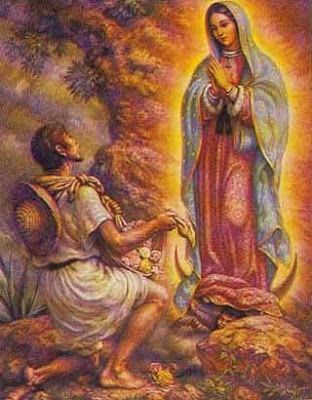
Juan Diego is dazzled by the incredible beauty and miraculous nature of Our Lady's appearance. She appears as a native princess to him, and her words sound more beautiful than the sweetest music ever made.
Our Lady calms the startled traveler, and assures him of who she is. She instructs Juan Diego to visit his bishop and ask that a temple be built on the site of her appearance, so that she will have a place to hear petitions and to heal the suffering of the Mexican people. "Now go and put forth your best effort," Our Lady instructs.
Visibly shaken, Juan Diego approaches the Bishop who is initially very skeptical of his account. What did this peasant truly want? Does he merely seek attention? Notoriety? Money? Or is he possessed by demons? Has Juan Diego been tricked by the Devil?
The Bishop patiently listens to Juan Diego's accounts and dismisses him. The humble farmer has failed.
Second Apparition
Juan Diego begins to doubt himself. He returns to Tepeyac Hill where he hopes for some conformation of what he's experienced. Indeed, Our Lady does not disappoint, for she appears again, as radiant as before. Juan Diego tells Our Lady what she already knows, that the Bishop did not believe him. She instructs him to return the next morning and ask again.
Third Apparition
The Bishop is beside himself. Why did this peasant insist on telling this story? How could he know if the peasant was lying or perhaps insane? At their second meeting, the Bishop asks for a sign. Juan Diego makes a promise he won't keep, saying he will return the very next morning with a sign from Our Lady.
The bishop, seeing that he ratified everything without doubt and was not retracting anything, dismissed Juan Diego. Immediately he ordered some persons of his household, in whom he could trust, to go and watch where he went and whom he saw and to whom he spoke. So it was done. Juan Diego went straight to the avenue. Those that followed him, as they crossed the ravine, near the bridge to Tepeyacac, lost sight of him. They searched everywhere, but he could not be seen. Thus they returned, not only because they were disgusted, but also because they were hindered in their intent, causing them anger. And that is what they informed the bishop, influencing him not to believe Juan Diego; they told him that he was being deceived; that Juan Diego was only forging what he was saying, or that he was simply dreaming what he said and asked. They finally schemed that if he ever returned, they would hold and punish him harshly, so that he would never lie or deceive again.
In the meantime, Juan Diego was with the Blessed Virgin, relating the answer he was bringing from his lordship, the bishop.
But that evening, Juan Diego returns home to find his uncle, Juan Bernadino, who is 68 years old, and suddenly, terribly ill. The illness is known to the people there and it brings a burning fever so hot, it's almost always fatal. Juan Diego cannot leave his uncle's bedside to keep his pledge to the Bishop. He spends two days with his uncle, trying to save him. When it becomes apparent his uncle is about to die, he leaves to find a priest who can prepare him for death.
Fourth Apparition
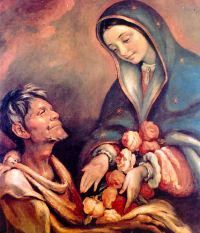
Frightened and saddened, Juan Diego sets off in a great hurry, time is running out, and Juan Diego is afraid his uncle will die without a last confession. On the road, in his way, Our Lady appears for a fourth time. Upset and afraid, Juan explains himself. Our Lady replies, "Am I not your mother? ... Are you not in the crossing of my arms?" she asks.
Shamed by the admonishment, but emboldened by Our Lady's presence, Juan Diego asks for the sign he promised to the Bishop. He knows he is wrong to doubt Our Lady. Juan Diego is instructed to climb to the top of Tepeyac Hill where he will find flowers. He is to pick the flowers there, which are unlike any he has seen before, and he is to keep them hidden in his tilma until he reaches the Bishop.
Juan Diego is skeptical again. It's December, what flowers could grow on the summit of the hill in this cold?
Nevertheless, he obeys and atop the hill he finds a great number of flowering roses which he picks and hastily gathers into his cloak.
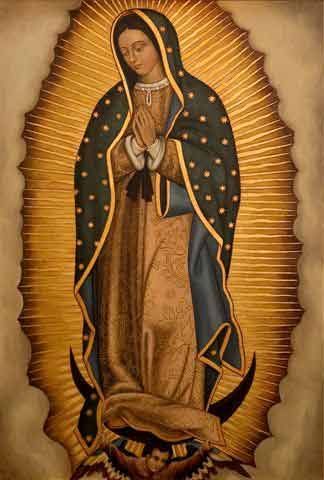
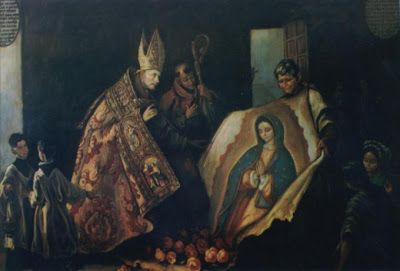
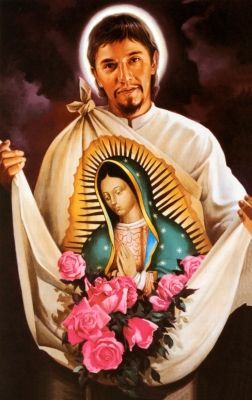
For the third time, Juan Diego is ushered in to see the Bishop. The skeptical cleric has waited for two days to see what sign Our Lady has for him. Juan opens his tilma, letting the roses cascade to the floor. But more than the roses, both men are astonished to see what is painted on his humble tilma - an exquisite image of Our Lady.
In the image, she stands as she appeared, a native princess with high cheekbones. Her head is bowed and her hands are folded in prayer to God. On her blue cloak, the stars are arranged as they appeared in the morning darkness at the hour of her first apparition.
Under her feet, is a great crescent moon, a symbol of the old Aztec religion. The message is clear, she is more powerful than the Aztec gods, yet she herself is not God.
Apparition to Juan Bernadino
At the same time Our Lady is appearing to Juan Diego, and directing him to cut the flowers on Tepeyac Hill, she also appears to his uncle, Juan Bernadino who believes he is about to die. As soon as she appears, the fever stops and Juan Bernadino feels well again. She tells Juan Bernadino, she wants to be known as "Santa Maria, de Guadalupe."
Our Lady of Guadalupe did not appear again, for her mission was complete. The temple was built and remains there today, in what is now a suburb of Mexico City.
Juan Diego's tilma, woven from cactus fibers, with a shelf-life of just 30 years at best, remains miraculously preserved.
After the Apparitions
Following the events of the apparition, Bishop Juan de Zumárraga placed Juan Diego in charge of the new chapel where he spent the remainder of his life explaining the message and the meaning of the visions to the pilgrims who came there.
News of the apparition were becoming common knowledge everywhere. As a result, 9 million Aztecs (out of 10 million) converted to the Catholic faith.
Saint Juan Diego
On July 31, 2002, Juan Diego was canonized before a crowd of 12 million, and later that year included in the General Calendar of the Roman Rite, as optional memorials, the liturgical celebrations of Saint Juan Diego Cuauhtlatoatzin (December 9th) and Our Lady of Guadalupe (December 12th).
Why is Our Lady of Guadalupe so important?
At the time of the apparitions of Our Lady of Guadalupe in the 16th century, the Protestant Reformation was resulting in millions of people in Europe leaving the Church. During this massive departure from the Old World, the image and story of Our Lady of Guadalupe helped to convert millions in the New World. To this day, Our Lady of Guadalupe is incredibly significant to the Mexican people. She is the patron of Mexico and is truly interwoven into Mexican culture.
Our Lady of Guadalupe is also revered throughout the Catholic world. In fact, the apparition site of Our Lady of Guadalupe has become the most visited Catholic pilgrimage destination on earth.
The Basilica of Our Lady of Guadalupe
The Basilica of Our Lady of Guadalupe or Basílica de Nuestra Señora de Guadalupe in Spanish enshrines the original tilma of Juan Diego that bears the Image of Our Lady of Guadalupe.
The new Basilica was built by Mexican architect Pedro Ramírez Vásquez between 1974 and 1976 near the site where Our Lady of Guadalupe appeared to Juan Diego Cuauhtlatoatzin.
The Basilica is considered as the second most important sanctuary of the Roman Catholics next to the Vatican City. It is also one of the most visited pilgrimage sites visited by several million pilgrims every year, especially around December 12, Our Lady of Guadalupe's Feast day.
It was reported that, on December 11 to 12, 2009, a record number of 6.1 million pilgrims visited the Basilica to commemorate the anniversary of the apparition.
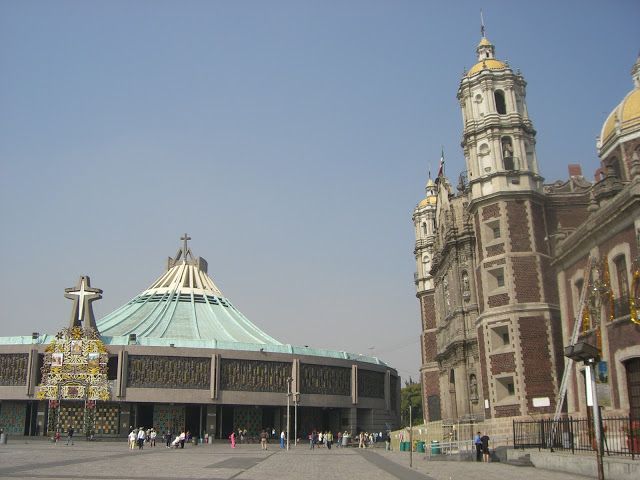
The new Basilica of Our Lady of Guadalupe (left) next to the old basilica which is literally sinking into the ground under its own weight
What about the Miraculous Image of Our Lady of Guadalupe?
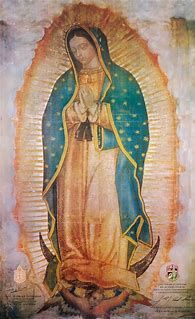
The symbolism of Our Lady's dress is obvious to over eight million Native Mexicans, whom all speak different languages. She is brighter than the sun, more powerful than any Aztec god, yet she is not a god herself, and she prays to one greater than her.
Her gown is adorned with stars in the correct position as in the night sky, and the gold fringe of her cloak mirrors the surrounding countryside. Millions of natives will convert at the news of what has happened. Millions more will make pilgrimages over the next five centuries to see the miraculous tilma, and to honor Our Lady of Guadalupe. Great miracles continue to occur, even today.
On October 12, 1945, Pope Pius XII, decreed Our Lady of Guadalupe to be "Patroness of all the Americas." Her feast day is December 12, and it is a Holy Day of Obligation in Mexico.
What was Juan Diego’s tilma made of?
The tilma was made from agave thread, a very fragile fabric that is known to disintegrate in 20-40 years. The tilma of Our Lady of Guadalupe is the only existing agave fabric from the 16th century, even though it was left unprotected for more than a hundred years. At that time, the tilma was exposed to smoke and incense and was also touched by many people every day.
Is Our Lady of Guadalupe a painting?
No, the image of Our Lady of Guadalupe was not created by any human hand, or according to any process of painting, staining, or printing known either then or today. Nor does the cloth contain any artifacts of any process, such as paint. Scientifically, it is inexplicable.
How was the image created?
The image itself has all the characteristics of a miracle. In 1936, biochemist Richard Kuhn – who later won the Nobel Prize – said that the source of the image was unknown (not animal, mineral, or vegetable).
Also, Dr. Philip Serna Callahan photographed the tilma under infrared light and said that the image of the Virgin Mary had been formed without brush strokes.
Other researchers have described its character as closest to a photograph, yet created 300 years before the invention of photography.
about the Miraculous Image of Our Lady of Guadalupe.
What are the miracles of the tilma?
The tilma defies the efforts of science to explain its creation, its survival, or its details.
Regarding Its Creation:
- No method of art or technology has been identified that could have produced the image.
- Like the Shroud of Turin, it is most like a photograph – the Shroud a negative image, the Tilma a positive image.
Regarding Its Survival:
- The tilma has survived for 500 years, despite being made of cactus fiber, which typically disintegrates in 20-40 years.
- For much of that time, it was exposed uncovered to the heat, humidity, and sunlight of the church where it was displayed and venerated by the people, which contributed to its deterioration.
- Nitric acid was spilled on the tilma in 1791, and it was repaired miraculously with no external aid.
- Unprotected, it survived unscathed a bomb attack in 1921, which damaged the altar and bent a brass crucifix upon it.
Regarding Its Details:
- The position of the stars on the image conforms to the constellations as they were on December 12, 1521, when the image was created.
- Recent investigations have shown that when the tilma is enlarged 2,500 times, the Virgin Mary’s eye has the reflection of all of the people who were present when the tilma was revealed to the archbishop.
These are just some of the unbelievable discoveries that have been made about the image.
John Paul II's Prayer to Our Lady of Guadalupe
O Immaculate Virgin, Mother of the true God and Mother of the Church!, who from this place reveal your clemency and your pity to all those who ask for your protection, hear the prayer that we address to you with filial trust, and present it to your Son Jesus, our sole Redeemer.
Mother of Mercy, Teacher of hidden and silent sacrifice, to you, who come to meet us sinners, we dedicate on this day all our being and all our love. We also dedicate to you our life, our work, our joys, our infirmities and our sorrows. Grant peace, justice and prosperity to our peoples; for we entrust to your care all that we have and all that we are, our Lady and Mother. We wish to be entirely yours and to walk with you along the way of complete faithfulness to Jesus Christ in His Church; hold us always with your loving hand.
Virgin of Guadalupe, Mother of the Americas, we pray to you for all the Bishops, that they may lead the faithful along paths of intense Christian life, of love and humble service of God and souls. Contemplate this immense harvest, and intercede with the Lord that He may instill a hunger for holiness in the whole people of God, and grant abundant vocations of priests and religious, strong in the faith and zealous dispensers of God’s mysteries.
Grant to our homes the grace of loving and respecting life in its beginnings, with the same love with which you conceived in your womb the life of the Son of God. Blessed Virgin Mary, protect our families, so that they may always be united, and bless the upbringing of our children.
Our hope, look upon us with compassion, teach us to go continually to Jesus and, if we fall, help us to rise again, to return to Him, by means of the confession of our faults and sins in the Sacrament of Penance, which gives peace to the soul.
We beg you to grant us a great love for all the holy Sacraments, which are, as it were, the signs that your Son left us on earth.
Thus, Most Holy Mother, with the peace of God in our conscience, with our hearts free from evil and hatred, we will be able to bring to all true joy and true peace, which come to us from your son, our Lord Jesus Christ, who with God the Father and the Holy Spirit, lives and reigns for ever and ever.
Amen.
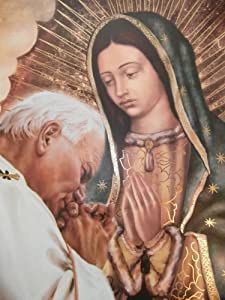
In 1910 Our Lady of Guadalupe was declared Patroness of Latin America by Pope St. Pius X, and in 1945 Pope Pius XII declared her to be the Empress of all the Americas.
On January 22, 1999 Pope Saint John Paul II named Our Lady of Guadalupe patroness of the Americas and raised December 12 to the rank of Feast for all the countries of the Americas.